Bavona Valley: Inside Switzerland’s Off-Grid Canyon of Ancient Rock Shelters
Tucked deep into a steep-sided canyon in Switzerland’s southern canton of Ticino, the Bavona Valley remains one of the Alps’ most remote and untamed landscapes. Stretching just 12.1 kilometers in length and home to only 11 permanent year-round residents, the valley preserves centuries-old survival architecture found nowhere else in the country.
Ancient Splüi: Turning Fallen Boulders into Shelters
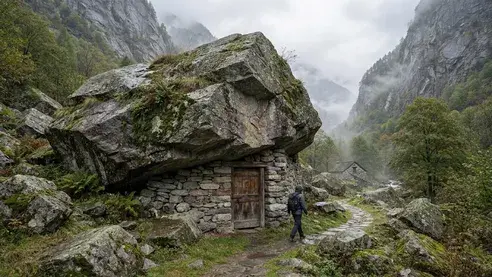
Scattered across the valley floor like fallen meteors are hundreds of splüi—gigantic boulders hollowed out and fitted with dry-stone walls and wooden doors by generations of mountain inhabitants. Around 405 examples of this distinct rock architecture have been documented across the wider Maggia Valley region, with the oldest surviving structures dating back to the Middle Ages.
With treacherous terrain leaving just 1.5% of the valley suitable for cultivation, early settlers relied on extreme ingenuity to survive harsh weather, floods, and rockfalls. While families lived in two-storey stone houses known as rustici, the splüi served vital practical purposes—functioning as cool cellars, cheese and wine stores, haylofts, chestnut smokehouses (grà), and even raised rooftop vegetable gardens.
“Traditional barns are a common feature of the Alpine landscape. But the ancient splüi are found only here,” local guide Tanya Harvey Ciampi noted while leading visitors along the scenic 13.8-kilometer Transhumance Trail.
11 Off-Grid Hamlets Reject Modern Power
As Switzerland rapidly modernized in the mid-20th century, the Bavona Valley deliberately chose to preserve its traditional way of life. When hydroelectric power plants and dams were constructed in the 1950s, 11 out of the valley’s 12 stone hamlets (terre)—including Foroglio, Sonlerto, Mondada, and Sabbione—voted against connecting to the national electricity grid, leaving San Carlo as the sole exception.
Today, most stone cottages rely on wood-burning stoves, gas hobs, and modest solar panels introduced in the 1980s for basic refrigeration. During the off-season in autumn and winter, restaurants and shops remain closed, leaving visitors and the handful of full-time locals surrounded by dramatic waterfalls, chestnut groves, and silence.
Preserving a Living Cultural Heritage
Although regular snow-plough clearing now allows dedicated year-round residents—such as artisans Roberto and Nadia Pedrazzini in Sonlerto—to remain through winter without being snowed in, most families still occupy the valley only during summer.
Conservation leaders at the Fondazione Valle Bavona continue to safeguard the valley’s architectural heritage so visitors experience an untouched landscape. As foundation director Rachele Gadea Martini explained, the ancient splüi stand as enduring monuments to human adaptability—demonstrating how mountain communities lived in close symbiosis with nature.