Evolution of Muslim Politics in American Democracy
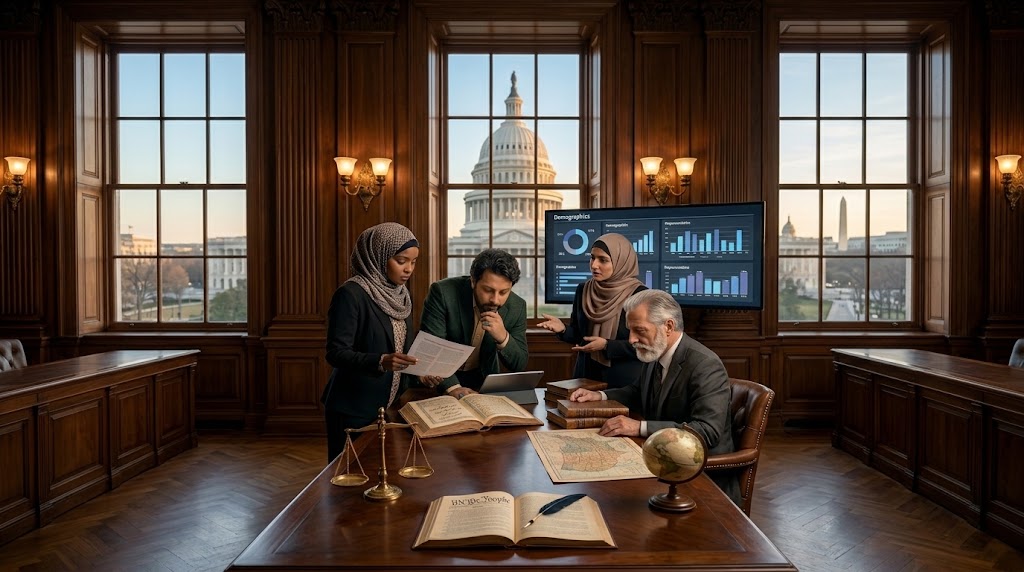
Evolution of Muslim Politics in American Democracy: A Philosophical and Practical Journey from Washington’s Corridors to Local Institutions
Written by: Mir Hasan Ali Kazmi
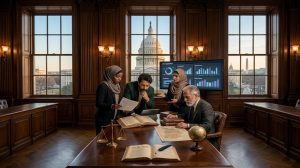
The American political landscape has historically served as a sanctuary for diverse linguistic, religious, and cultural currents. However, the most significant and prominent shift on the canvas of American politics over the first two decades of the twenty-first century is the increasingly active role of Muslim Americans in public representation. In the past, the political activities of the Muslim community were largely perceived to be limited to voting or operating within lobby groups based in central institutions in Washington, D.C. Today’s reality, however, is that American Muslim leadership has transcended the boundaries of Washington to establish an effective presence in the foundational institutions of civic life—school boards, city councils, state legislatures, and municipal electoral offices.
This shift is not the result of an abrupt occurrence, but the fruit of decades of civic awareness, legal struggle, and active engagement with institutions. Evidence provided by reputable civil rights and representation organizations demonstrates how a minority community has utilized its constitutional rights within American democracy to secure a foothold on key decision-making platforms.
Historical Context: From Keith Ellison to the Corridors of Congress
An examination of the milestones of Muslim representation in American history leads naturally to the highest legislative body in Washington, D.C.
-
Keith Ellison: In 2006, Keith Ellison’s election to the U.S. House of Representatives from Minnesota’s 5th Congressional District marked a historic event. According to reports by The New York Times and the Associated Press, he became the first Muslim politician elected to Congress in American history. Ellison subsequently won the election for Attorney General of Minnesota, assuming a key state-level office dedicated to protecting civil rights and upholding the rule of law.
-
André Carson: In 2008, André Carson entered Congress representing Indiana’s 7th Congressional District. According to records from National Public Radio (NPR), he became the first Muslim lawmaker on Capitol Hill to chair a subcommittee of the House Permanent Select Committee on Intelligence, serving as evidence of his key role in overseeing U.S. national security policies.
-
Ilhan Omar and Rashida Tlaib: The 2018 midterm elections marked a new chapter in history with the election of Ilhan Omar (of Somali descent) from Minnesota and Rashida Tlaib (of Palestinian descent) from Michigan. Both became the first Muslim women to serve in the U.S. Congress. According to analytical reports by CNN and Reuters, their victories reshaped discussions around U.S. foreign policy and fundamental human rights while opening political doors for women from minority backgrounds.
Local Governance and Foundational Institutions: Data-Driven Landscape of 2025–2026
The strength of public politics is measured by representation within institutions that directly affect citizens’ daily lives. The political progress of Muslim Americans is no longer confined to national figures; its primary center has shifted to local and state governments.
According to detailed statistics released in the 2026 Directory of Elected Muslim Officials by the Council on American-Islamic Relations (CAIR)—the largest Muslim civil rights organization in the U.S.—and its political arm, CAIR Action:
-
State Legislators: Across various state legislatures in the United States, 44 state officials are actively serving and legislating.
-
Mayors and Local Leadership: Across American cities and towns, 11 Muslim mayors lead municipal administrations.
-
City Council Members: 87 city council members actively influence local municipal systems, development projects, and policing policies.
-
School Board Members: 58 school board members oversee education and curriculum policies within local educational institutions.
-
Judiciary: Within the branch guaranteeing legal and constitutional protections, 17 elected judges preside over courts to ensure the administration of justice.
Furthermore, expanded reports from election commissions and international news outlets regarding the 2025 local and state elections indicate that a total of 42 Muslim Americans were elected to public office, including five mayors, four state legislators, and two judges.
Historic Milestones: Two Major Outcomes of 2025
The 2025 U.S. local and state elections brought two victories covered by the international press as major milestones in democratic evolution:
-
Zohran Mamdani – First Muslim Mayor of New York City: In the November 2025 New York City mayoral election, Democratic candidate and former New York State Assembly member Zohran Mamdani secured a historic victory by winning over 50 percent of the vote. According to reports by The New York Times and the BBC, Mamdani emerged as the first Muslim mayor of New York City—the nation’s foremost economic and cultural center. His campaign focused on public transportation infrastructure, rent stabilization for housing, and protecting working-class rights, introducing a fresh direction to urban politics.
-
Ghazala Hashmi – First Muslim Lieutenant Governor: In the same November 2025 elections, Democratic State Senator Ghazala Hashmi won the race to become the Lieutenant Governor of Virginia. According to coverage by the Associated Press (AP) and PBS, Indian-born educator and professor Ghazala Hashmi became the first Muslim Lieutenant Governor of any U.S. state in history. Her journey from winning a seat in the Virginia State Senate in 2019 to achieving the state’s second-highest constitutional office serves as a clear illustration of political empowerment among American Muslim women.
Other Prominent Figures and Notable Officials
Several other figures have left significant marks across legislative, judicial, and administrative branches:
-
Sadaf Jaffer & Ruwa Romman: Sadaf Jaffer made history in 2018 as the first Muslim woman to serve as mayor of a U.S. municipality (Montgomery, New Jersey), later becoming a member of the New Jersey General Assembly. Similarly, Ruwa Romman serves in the Georgia House of Representatives as the first Palestinian-American Muslim woman elected to the body.
-
Aisha Wahab: In California, Afghan-American Aisha Wahab won a seat in 2022 to become the first Muslim woman elected to the California State Senate, representing a prominent voice in state governance.
-
Administrative Appointments: Beyond elected positions, Zahid Qureshi stands out in the judicial branch after being nominated as the first Muslim-American lifetime federal judge on the U.S. District Court for the District of New Jersey, a nomination confirmed by the U.S. Senate.
Civic Engagement, Challenges, and the Future of Democracy
The expanding presence of the Muslim community in American politics is not merely an accumulation of individual triumphs; it is backed by research and statistical institutions such as the Institute for Social Policy and Understanding (ISPU) and CAIR. Survey findings from these institutions demonstrate that civic education initiatives, voter registration drives, and public service leadership training for youth have fostered heightened political engagement.
Challenges remain along this path, including prejudice, political scrutiny, and persistent concerns surrounding Islamophobia. Nonetheless, from participating in school board debates over local educational policy to drafting legislation in city halls and senate chambers, Muslim Americans have demonstrated that they are active decision-makers rather than passive observers.
From the central chambers of Washington to local municipal bodies across the nation, the evolution of Muslim politics embodies the foundational democratic principle of government “of the people, by the people, for the people”—ensuring equitable and dignified representation for citizens of all religious and cultural backgrounds.